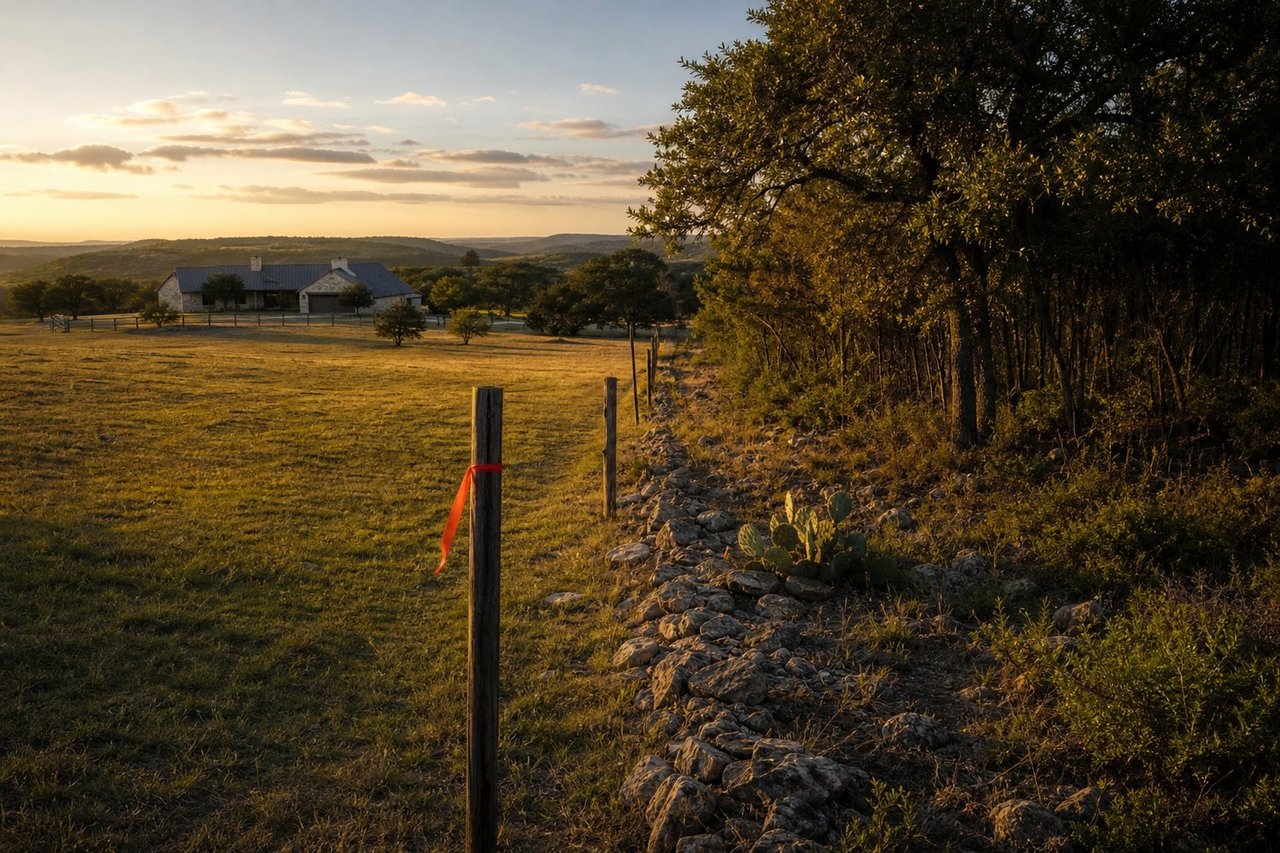
Start with the dirt, not the acreage number. In the Hill Country, a tract's value comes from reliable water, legal access, a buildable site, and septic feasibility. Verify those four before you fall for the view, then price the land against comparable parcels in the same county, not a regional average.
What Should You Know Before Buying Acreage in Hill Country Estates?
Acreage in Hill Country estates is priced on what the land can support, not just how big it is. The most recent Texas Real Estate Research Center report, covering Q2 2026, put the Austin-Waco-Hill Country region at $8,040 per acre, up 8.63% year over year. Your parcel will land above or below that depending on water, access, septic feasibility, and slope, so verify those four before you fall for the view.
Key Takeaways
- The Austin-Waco-Hill Country region recorded $8,040 per acre in Q2 2026, up 8.63% year over year, compared with $5,218 per acre statewide.
- The regional typical tract was 199 acres, so that benchmark leans toward large ranches and says little about a 5 to 20 acre homesite.
- A listing that says "well" does not prove the quantity or quality of water you need for a house, livestock, or irrigation.
- Steep slopes, exposed limestone, and drainage channels can shrink a big tract's buildable area to a fraction of the acreage on paper.
- "Hill Country" listings near Austin can sit in Travis, Hays, Williamson, Blanco, Burnet, and other counties, and each county's rules and appraisal practices differ.
How Much Does Acreage in Hill Country Estates Cost Near Austin?
Regionally, land ran about $8,040 per acre in Q2 2026, but that is a benchmark across a broad area, not a price quote for a homesite near Austin. A tract with a permitted home site, paved access, and a proven well can sit well above it, and a steep, landlocked parcel can sit well below it.
Here is how the region compared with the rest of Texas in the most recent report available, from Q2 2026:
Q2 2026 measure | Texas statewide | Austin-Waco-Hill Country region |
|---|---|---|
Price per acre | $5,218 | $8,040 |
Price change, year over year | +3.27% | +8.63% |
Number of land sales, year over year | +4.34% | +2.61% |
Total acres sold, year over year | -12.57% | +2.92% |
Total dollar volume, year over year | -9.72% | +11.81% |
The figures come from the Texas Real Estate Research Center's Q2 2026 rural land report and its analysis of whether the Texas rural land market has hit a plateau. The pattern is worth noticing: statewide, fewer acres changed hands, while the Hill Country region saw more dollars and more acres move. Demand around Austin is holding up.
Why does the regional number mislead on small tracts?
Because the regional dataset logged 1,062 land sales in Q2 2026 with a typical tract size of 199 acres, down 4.32% from a year earlier. Large ranches drive that average. A 10-acre homesite with a view and a driveway is a different product, and Jeff Joseph walks buyers through that gap before they anchor on a per-acre figure from a headline.
What does a finished-home benchmark add?
It shows how negotiable the market is when you move from raw land to improved property. Recent local market data for single-family homes sold July through September 2026 in Crystal Falls shows a median sale price of $734,878, 37 homes sold, and 4.4 months of supply. Those homes sold at an average of 97.0% of list price, and 47% of listings had a price cut. That is an area-level snapshot of a finished-lot neighborhood, not acreage, but it tells you buyers have room to negotiate when pricing gets ahead of the market. An individual home's value still depends on condition, street, build year, and timing.
Hill Country living also costs more than most buyers expect once the purchase price is behind them. Private wells, septic systems, long driveways, fencing, and property maintenance are line items that a subdivision lot never asks of you. Jeff builds those into the conversation before an offer, not after.
What Should You Check Before Buying Hill Country Land?
Check legal access, water, wastewater, usable topography, and recorded restrictions before you rely on any listing description. Each of these can change what you are allowed to build, what it costs to build it, and what the property is worth when you sell.
Is the water reliable?
Not until you have documentation. For a property on a private well, identify the well's location, construction records, production history, and water-quality testing, plus any shared-well agreement and the groundwater conservation district that covers the parcel. "Has a well" is a feature, not proof of adequate supply for a residence, livestock, irrigation, or future improvements. Well capacity is one of the first questions Jeff raises on any acreage tour.
Can the land handle a septic system?
Confirm it before you assume you can build, and certainly before you assume you can add a second residence. The practical sequence is to verify the tract's jurisdiction, get the applicable site and soil evaluation, confirm which wastewater system type is permitted, and check that your planned improvements fit the usable area.
How much of the acreage can you actually use?
Often less than the listing suggests. Steep slopes, exposed limestone, shallow soils, drainage channels, karst features, and limited flat building sites can leave only a small part of a tract practical for the house, driveway, septic field, barn, or pool. Walk it, and order a survey (T-47) so you know where the boundaries and easements really are.
What restrictions and jurisdictions apply?
More than the mailing address implies. Use this checklist and verify each item against recorded documents and the relevant county or city:
- Legal access, recorded easements, and any private-road maintenance agreements
- Deed restrictions and any HOA rules on guesthouses, barns, or short-term rentals
- County and ETJ rules, including subdivision requirements that can limit splitting or adding residences
- Floodplain status and drainage on the parcel
- Utility availability, and whether the property sits in a MUD, PID, or WCID
- Groundwater district coverage and what it requires of a well
"Hill Country" near Austin can mean Travis, Hays, Williamson, Blanco, Burnet, Bastrop, Caldwell, Llano, or Gillespie County. Appraisal practices, emergency services, and development rules can differ from one to the next. Your option period is the window to line up the well test, survey review, and septic evaluation, so schedule them early.
How Do You Choose Between a Country Homesite and a Larger Estate?
Decide what you need the land to do, then buy the usable features, not the raw acre count. A smaller tract with dependable water, all-weather access, and a permitted home can be a better holding than a larger parcel you cannot build on.
When you compare acreage in Hill Country estates, line up the features that tend to support value over time. None of these guarantees appreciation, but they are what buyers here pay a premium for:
- Dependable water and a documented well
- Paved or all-weather access
- A permitted residence or confirmed septic feasibility
- Views, privacy, and mature trees
- Fencing and grazing or wildlife potential
- Reasonable distance to employment centers
What about property taxes on rural land?
Some rural acreage may qualify for agricultural or wildlife valuation (often called an ag exemption), but eligibility depends on how the land is used and on the county appraisal district's rules. Ask the appraisal district and your tax advisor before you count on it in your budget.
Where does a planned community fit in?
If you want Hill Country views and space without managing every detail of a private well and road, a planned community can be a middle path. The guide to Hill Country space in Grand Mesa shows what that looks like, and the Hill Country luxury home buying process walks through the steps from offer to close. For a look at how Jeff handles harder deals, see these luxury and acreage case studies.
Your specific numbers depend on the parcel, the county, and what you plan to build. That is where a parcel-by-parcel conversation beats any regional average, and it is exactly the work Jeff does with buyers before they write an offer. Texas also has no real estate transfer tax, one fewer line item to chase when you are comparing land purchases.
See what past clients say on Google, Zillow, and Realtor.com.
FAQ
How much does acreage near Austin cost in 2026?
The Austin-Waco-Hill Country region recorded about $8,040 per acre in Q2 2026, according to the Texas Real Estate Research Center. That is a regional benchmark dominated by larger tracts, so a smaller homesite near Austin can price very differently. Water, access, improvements, and views all move the number.
How do I find a Hill Country property with a well and reliable water?
Ask for the well's construction records, production history, and water-quality testing, and identify the groundwater conservation district that covers the parcel. A listing that says "well" does not establish adequate quantity or quality. Have the well evaluated during your option period, and confirm any shared-well agreement in writing.
Are there restrictions on building a guesthouse, barn, or short-term rental on Hill Country land?
Often yes, and they vary by parcel. Deed restrictions, HOA rules, county subdivision requirements, ETJ rules, and septic capacity can all limit a second residence or rental use. Check the recorded documents and the relevant county or city before you assume anything.
What should I check before buying undeveloped acreage in Texas?
Start with legal access, recorded easements, a current survey, floodplain status, utility availability, and wastewater feasibility. Then confirm the water source and any special districts such as a MUD or PID. Jeff walks buyers through this list so surprises show up before closing, not after.
Acreage in the Hill Country rewards buyers who verify the land's real capabilities before they fall for the acreage count. If you are weighing a country homesite against a larger estate, Jeff will help you compare specific parcels, county rules, and what each one can support. Schedule a Consultation to talk through your search, or Search Austin & Leander Homes to start looking at what is available.
Equal Housing Opportunity. Jeff Joseph, Texas Sales Agent, regulated by the Texas Real Estate Commission. This article is general information, not legal, tax, or financial advice; confirm your own numbers with your title company, tax advisor, or lender.