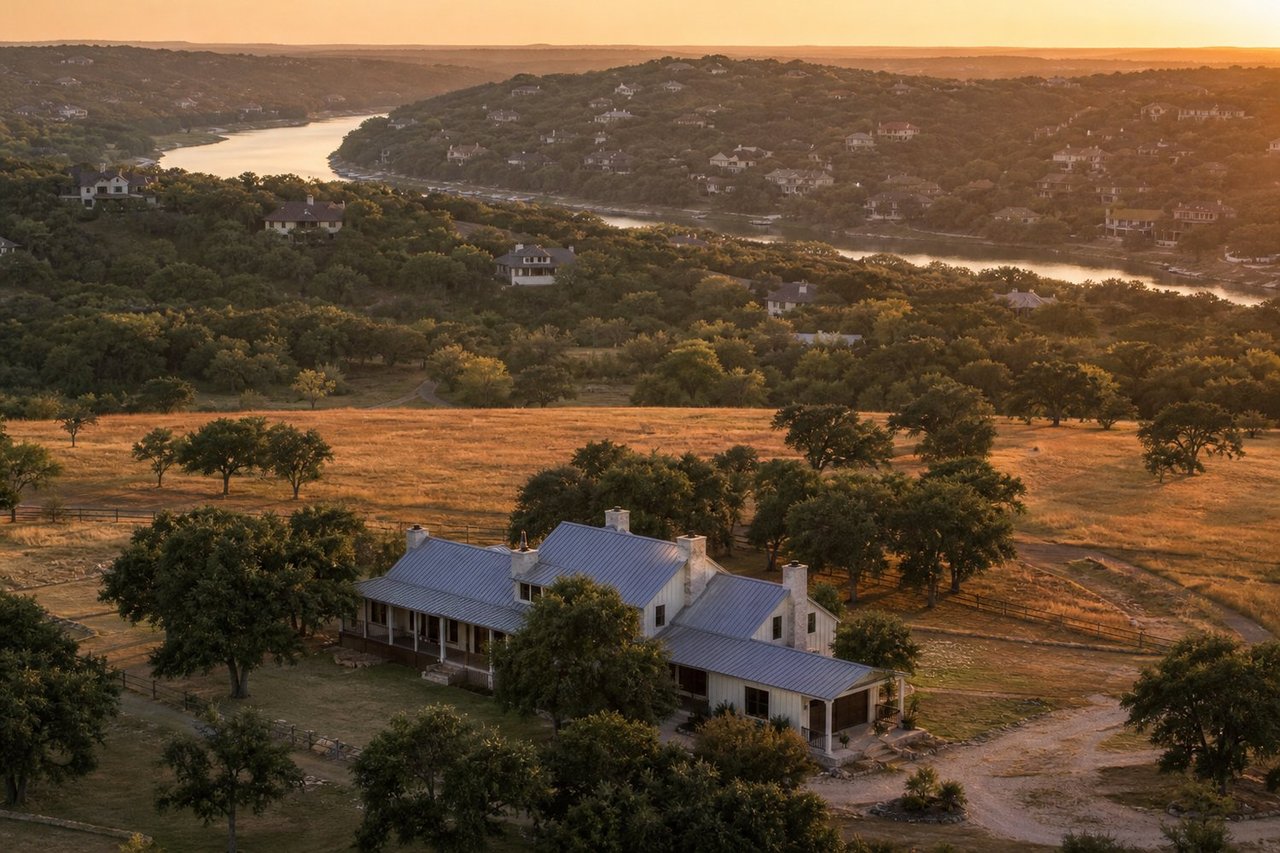
The house is only part of the price. What you're really buying is land, water, privacy, and access, and those four things decide whether an estate holds its value. With Austin-area ranch asking prices softer in 2026, the buyers who do well verify the infrastructure first and the finishes second.
What Makes Hill Country Estates Worth Buying Near Austin?
Hill Country Estates give you what a subdivision lot can't: real acreage, privacy, long views, and room for a pool, a barn, or a guest house. The Austin area has plenty to choose from in 2026. A June 2026 national report found 727 active ranch listings in the Austin metro, with a median asking price of $1.4 million, down 6.7% year over year, as reported by the Austin American-Statesman. The value in these properties comes from the land and its infrastructure as much as the house on it.
Key Takeaways
- The Austin metro had 727 active ranch listings in June 2026, the highest total among U.S. metros in the national comparison cited by the Austin American-Statesman.
- The median asking price for those ranch listings was $1.4 million in June 2026, down 6.7% year over year.
- Seven of the report's top 10 counties for ranch-listing volume sit in the Austin-area corridor: Burnet, Williamson, Bastrop, Blanco, Hays, Fayette, and Washington.
- In Crystal Falls, single-family homes sold August through October 2026 closed at 97.0% of list price on average, with 4.5 months of supply, so buyers in the surrounding market have room to negotiate.
- Water source, wastewater capacity, road access, flood exposure, and agricultural-use status should be verified separately from the house itself.
What Do Hill Country Estates Offer That a Suburban Luxury Home Doesn't?
They offer land you control: acreage, privacy, and a setting no neighbor can change. In Jeff's experience, that is what buyers here pay a premium for, and it's why Texas luxury looks different from Beverly Hills or the Hamptons.
Acreage, views, and privacy
A Hill Country estate is priced on what surrounds the house. Sunset exposure over the hills, a ridge or valley view, a long private drive, a pool positioned to use both, and enough distance that you can't see the next roof. Name those features early in any search, because they move value more than square footage does.
The most expensive homes in Texas are often the least flashy. Stone, timber, restraint, and a site that does the talking. Buyers who know the market can spot pretense quickly, and they know which builders and which streets deliver the real thing.
Water, wells, and agricultural use
Land brings questions a suburban home never raises. Is the water from a public system or a well, and what is the well's capacity? Is the property under an agricultural exemption, and what would it take to keep it? Those answers shape both your carrying costs and what you can do with the land. Confirm agricultural-use status with the county appraisal district rather than assuming it carries over.
If you want more of the lifestyle without the full acreage commitment, master-planned communities are a different product. Jeff covers that side in his look at living in Travisso. For true acreage, start with his breakdown of acreage in Hill Country estates near Austin.
What Does the Austin Ranch Market Look Like in 2026?
It is deep and softening on asking price. Austin led the national comparison in ranch inventory in June 2026, and the median asking price came down from the year before.
Measure | Figure | Source and period |
|---|---|---|
Active ranch listings, Austin metro | 727 | Austin American-Statesman, June 2026 report |
Median asking price, ranch listings | $1.4 million | Austin American-Statesman, June 2026 report |
Year-over-year change in median asking price | Down 6.7% | Austin American-Statesman, June 2026 report |
Top-10 counties for ranch-listing volume in the Austin-area corridor | Seven: Burnet, Williamson, Bastrop, Blanco, Hays, Fayette, Washington | Austin American-Statesman, June 2026 report |
Those figures come from the June 2026 ranch-listing report, the most recent data available on this question. They describe asking prices, not what sold, and a median across a whole metro tells you nothing about one property. A well-sited estate with proven water and clean access is a different animal from a tract with none of that.
How much negotiating room do buyers have?
More than they did, though it depends on the property. Recent local market data for Crystal Falls, the suburban luxury market next to the acreage corridor, shows single-family homes sold August through October 2026 closed at 97.0% of list price on average. None sold above list and 79% sold below it. 46% of listings had a price cut, averaging 3.4%, and months of supply sat at 4.5. Only 29% went under contract within two weeks of listing.
That is a market where pricing discipline and patience pay off. These are area-level numbers, and an individual home's value depends on condition, street, build year, and timing.
Is a Hill Country estate a good investment?
It can be, with an honest read of the cycle. The structural story is steady: Sunbelt migration, no state income tax, a deep tech employer base, the lifestyle draw, and scarce land with a Hill Country premium. Texas also has no real estate transfer tax. But the 6.7% drop in median ranch asking price shows the market doesn't move in one direction, and no one can promise appreciation on a specific property. Waterfront estates add another variable, since Lake Travis levels materially affect valuations.
The comp work is also different. In a subdivision, Jeff's method looks at sales within about a quarter mile or in the same subdivision over the past 90 days, and it widens to 180 days when fewer than three comps turn up. Acreage rarely gives you that many clean matches, so the analysis leans harder on land characteristics, infrastructure, and judgment. That is the kind of work a local market analysis is built for.
What Should You Check Before Buying Hill Country Acreage?
Check the infrastructure before the finishes: water, wastewater, access, flood exposure, utilities, and restrictions. There is no single Hill Country standard for these items, so each property needs its own review.
What to verify | Why it matters |
|---|---|
Water source and well capacity | Determines whether the property supports the house, pool, landscaping, and any livestock or outbuildings you plan. |
Wastewater system | A septic system's capacity and condition affect what you can add or expand. |
Road access and easements | Private drives, shared roads, and easements affect maintenance obligations and daily use. |
Terrain and flood exposure | Slope, drainage, and creek or floodplain exposure affect buildable area and insurance. |
Utilities and connectivity | Electric, internet, and gas availability vary widely outside city limits. |
Agricultural-use status | Affects property tax treatment and what you must do to keep it. Confirm with the county appraisal district. |
Taxing districts and restrictions | MUD, PID, WCID, ETJ status, deed restrictions, and fencing or outbuilding rules shape cost and use. |
Survey and boundaries | Confirms acreage, fence lines, and encroachments before you are committed. |
In Texas, your option period is the window to get inspections, well and septic evaluations, and the survey done while you can still negotiate or walk. Work out who you'll hire before you write the offer, not after. Jeff walks clients through the full sequence in his guide to the Hill Country luxury home buying process.
Is it better to buy a finished estate or build on raw land?
A finished estate gives you certainty on timeline and a house you can walk through. Raw land gives you control over siting, views, and design, but you carry the risk on well drilling, septic design, utility extension, and construction. If you're weighing new construction, the builder matters as much as the lot, and Jeff's new construction background applies directly here. The right choice depends on your timeline, your tolerance for uncertainty, and how specific your vision is.
What does owning a large estate cost beyond the purchase price?
More than most buyers expect. Lake and Hill Country living has a real carrying cost, and Jeff would rather you hear that before you offer than after you close. The categories include:
- Property taxes, including any MUD, PID, or WCID taxes that apply to the property
- Well and septic upkeep
- Insurance, which can vary with location, flood exposure, and outbuildings
- Fencing, gates, and road or drive maintenance
- Land management, from brush and tree work to pasture upkeep
Your actual numbers depend on the specific property, and that is where a conversation with Jeff before you tour saves you from surprises.
How Do You Sell or Buy a Hill Country Estate With Discretion?
You work with an agent who treats privacy as part of the job. Jeff spent a career in the Austin Police Department Bomb Squad before real estate, where calm decisions, detail, and absolute trustworthiness were the job. What a client shares with him stays with him.
For sellers, the buyer pool for an estate is narrower than for a suburban home, which makes positioning and preparation matter more. Cinematic video, strong digital exposure, and targeted outreach through the ERA Experts network put the property in front of qualified buyers without turning it into a public spectacle. Price to the data, not the ego. Buyers in this segment know land, and they check.
If you're buying, a local perspective on which corridors offer privacy without a punishing drive is worth having. Jeff explains what to expect from representation in his post on luxury REALTOR service in Leander, Lakeway, and the Hill Country.
Want to hear what past clients say about working with Jeff? Read his reviews on Google, Zillow, and Realtor.com.
FAQ
Are Hill Country estates near Austin a good long-term investment?
They can be, but the value depends on land, water, and access more than the house. Austin's long-term drivers include migration, no state income tax, and scarce Hill Country land. Still, the median ranch asking price fell 6.7% year over year in June 2026, so there are no guarantees. A property-specific analysis is the only reliable way to judge one.
How much does Hill Country acreage cost per acre around Austin?
It varies too much by county, water availability, access, and terrain for one honest number. The $1.4 million median asking price from the June 2026 ranch report covers whole properties, not a per-acre rate. Jeff can pull per-acre comparisons for the specific area and acreage you're considering.
Which Austin-area counties offer the most ranch and estate listings?
Burnet, Williamson, Bastrop, Blanco, Hays, Fayette, and Washington counties were among the top 10 nationally for ranch-listing volume in the June 2026 report. Travis County and the western Hill Country around Dripping Springs, Bee Cave, Lake Travis, Leander, and Liberty Hill are also common estate search areas. Each has its own tax, water, and access picture.
Is it better to buy a finished Hill Country estate or build on raw land?
Buy finished if you want certainty and a faster move, and build if siting and design control matter more. Raw land adds work on wells, septic, utilities, and construction. Either path is easier with the land vetted first.
What should I inspect before buying a large-acreage property in the Texas Hill Country?
Start with the well and its capacity, the septic system, road access and easements, drainage and flood exposure, utilities, and any deed restrictions. Order a survey, and confirm agricultural-use status and any MUD, PID, or WCID taxes. There is no single universal timeline or cost for these, so scope them to the property.
The core takeaway is simple: in Hill Country estates, the land and its infrastructure carry the value, and 2026's softer asking prices reward buyers who verify before they commit. Jeff brings local knowledge, a data-driven approach, and the discretion this kind of purchase calls for.
Schedule a Consultation to talk through an estate you're considering or the one you're preparing to list. You can also Search Austin & Leander Homes on your own.
Equal Housing Opportunity. Jeff Joseph, Sales Agent, licensed by the Texas Real Estate Commission. This article is general information, not legal, tax, or financial advice. Confirm your own numbers with your title company, tax advisor, or lender.