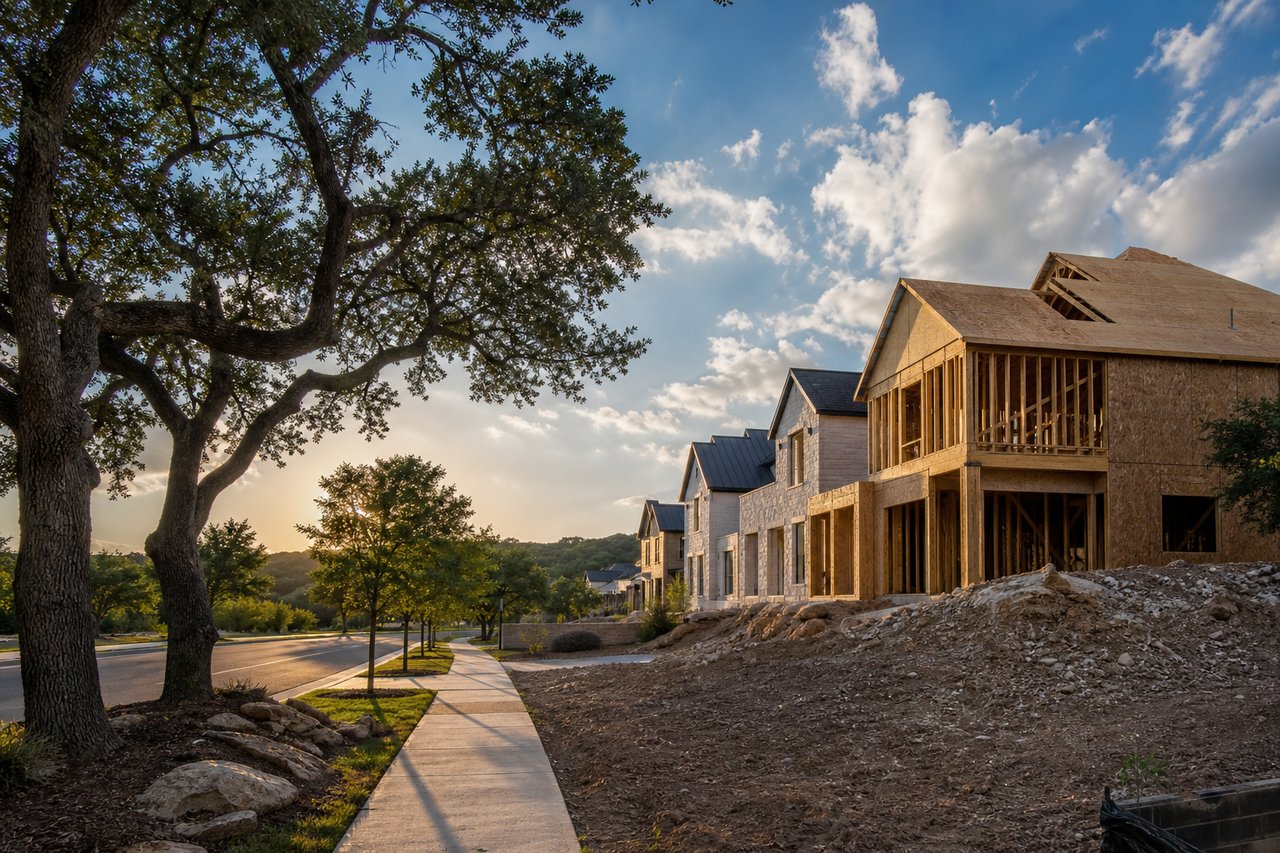
Leander and Cedar Park growth affects future homeowners through road projects, utility capacity, tax districts, and construction timing more than through any single price trend. The latest available figures are county and metro level, so the smart move is to judge each address by what is funded, what is only proposed, and what is already built.
Growth Affects Future Homeowners in Leander and Cedar Park
How Growth Affects Future Homeowners in Leander and Cedar Park
Growth affects future homeowners in Leander and Cedar Park in two ways: access and demand improve as roads, utilities, and amenities get built, while the years of construction in between can bring noise, detours, and uncertainty. The most recent figures, from August 2026, are county and metro level, so no one can honestly hand you a Leander-only or Cedar Park-only price forecast. What you can do is separate funded projects from proposed ones and judge each address on its own.
Key Takeaways
- The most recent report, from August 2026, put the Austin metro median sales price at $425,000, down 2.4% year over year, while Williamson County showings rose 6.6%.
- Those are metro and county numbers, not Leander or Cedar Park numbers, so a city-level price trend should never be assumed from them.
- A $132 million Hero Way/RM 2243 upgrade began in January 2026, but the proposed Crystal Falls Parkway rail bridge (about $40 million in grant funding sought) has only a possible 2029 to 2032 window.
- Before you buy near growth, confirm utility service, MUD or PID taxes, and the construction schedule for the exact address, not the general area.
What do the 2026 market numbers say about Leander and Cedar Park?
They say the wider market is active but not running away on price, and they do not break out Leander or Cedar Park separately. According to the August 2026 Austin metro microdata report, closed sales in Williamson County rose 4.8% year over year, and pending sales rose 9.8% across the Austin-Round Rock-San Marcos metro. The metro median sales price was $425,000, down 2.4% from a year earlier.
Showing activity in Williamson County climbed 6.6% year over year in the same reporting period. Buyers are still looking, even while prices adjust. That combination is worth noticing: attention is up, pricing is flat to softer, and that can create room to negotiate on the right property.
Is the move toward outer communities real?
Yes, as a reported pattern. A local 2026 report described continued movement from central Austin toward outer communities, including Leander and Cedar Park, along with Round Rock, Georgetown, Hutto, Liberty Hill, and Pflugerville. That is a relocation pattern, not a government population count, so treat it as direction rather than a measurement.
What the numbers can't tell you
They can't tell you what your specific street will do. A county figure blends lake-adjacent estates, new construction, and older resale homes into one number. When Jeff values a home, he works from comps within a quarter mile or the same subdivision, sold in the last 90 days, built within 10 years of yours and within 300 square feet. If there are fewer than three, he widens to 180 days. That is the level where a price forecast is useful, and it is why a market analysis beats any headline.
For a wider look at how builders are shaping the county, Jeff broke down what Williamson County's new construction boom means for buyers and sellers.
Which road and water projects will change what homes near them are worth?
The Hero Way/RM 2243 upgrade is the major project already under construction. Others are proposed or still in planning, and a proposed project should never be priced into your offer as if it were finished. Here is how the main items stack up.
Project | Status | Reported timing | What to verify |
|---|---|---|---|
Hero Way/RM 2243 upgrade (Leander to Georgetown corridor) | $132 million project, under way | Began January 2026 | How your address reaches the corridor, and the construction impact until completion |
Rail bridge over Crystal Falls Parkway at US 183 | Proposed, with about $40 million in grant funding sought | Possible 2029 to 2032 | Whether funding is secured, design has started, and approvals are final |
City of Leander Capital Improvement Program | Fiscal Year 2026 program published | Varies by project | Project-level schedules and funding on the city's own page |
Regional water delivery (Brushy Creek Regional Utility Authority, Ronald Reagan storage-and-pump project) | Planned at a regional scale | Confirm with the utility | Capacity commitments and service for the specific subdivision |
What does the Hero Way project mean for buyers?
It is designed to improve east-west movement between Leander and Georgetown. According to Community Impact's Leander-Liberty Hill edition, the $132 million project upgrades Hero Way/RM 2243 toward a divided, controlled-access highway connecting the 183A Toll corridor with the Southwest Bypass. The same coverage notes that construction can create temporary congestion and may influence nearby development patterns.
The access benefit is most relevant to western and northern Leander. Homes whose daily route depends mainly on US 183, 183A, Ronald Reagan Boulevard, or FM 2243 may feel the project differently. Check how your drive actually runs, at the hours you would actually drive it.
Should you count on the rail bridge?
Not yet. City officials were seeking about $40 million in grants for a bridge over Crystal Falls Parkway at US 183. The reported preliminary schedule was about two and a half years for design and about three years for construction, which points to a possible 2029 to 2032 window. It is a proposal, not a completed commitment.
If you are weighing a home near that intersection, ask three things: is funding secured, has design started, and are final approvals in place? Until the answers are yes, treat any benefit as upside, not as part of your purchase price. For context on what is already arriving along that road, see what's moving into Crystal Falls Parkway.
Why does water capacity belong in a home search?
Because an approved subdivision is not the same as a confirmed one. The relevant question is whether utility service, capacity commitments, and the construction schedule are locked in for the community you are considering. The City of Leander's Capital Improvement Program is the right place to start for project-level details, rather than relying on marketing material from a builder or a portal.
How Growth Affects Future Homeowners Street by Street
The same project can help one address and hurt another, so you have to judge growth by distance, timing, and what is actually confirmed. Several projects discussed for the area run into 2028 or later, which means you need to separate immediate livability from expected future benefit. A road or trail may improve access eventually, while the construction period in between can bring noise, dust, detours, and shifting traffic patterns.
Does buying near a planned project help resale or add risk?
Both can be true. A funded, finished improvement can strengthen a location, while an unfinished one can make a home harder to live in and harder to show. The honest answer depends on the project's status and your timeline. If you plan to stay a decade, the construction years matter less than the end state. If you may sell in three years, they matter a great deal.
How should you evaluate a new subdivision when nearby land is still undeveloped?
Treat the undeveloped land next door as a question to answer, not a view to enjoy. Before you commit, run through this list:
- Utility service: confirm water and wastewater service and capacity commitments for that specific community.
- Construction schedule: ask how many phases remain, and what is planned on adjacent land through the city.
- Access: identify which roads your daily route depends on and whether any are under construction.
- Survey and plat: review the survey / T-47 and recorded plat for easements and what borders the lot.
- Taxes: confirm whether the address carries MUD, PID, or WCID taxes.
On that last point, Jeff gives straight talk upfront. A MUD or PID tax changes your monthly number in a way the list price never shows, and in growth corridors it is common enough that you should look at it before you fall in love with a floor plan. Confirm the districts and rates for the exact address, and do it before your option period ends.
Are new homes giving buyers more negotiating power in 2026?
Possibly, but it depends on the builder and the community, not on a city-wide rule. The available data shows a metro median that slipped 2.4% while pending sales and showings rose, which is a mixed signal. Whether a particular builder or seller will move on price, closing help, or upgrades is something you test with a real offer on a real property. Jeff walks buyers through that comparison, including how a new build stacks up against a resale home in the same area.
Leander or Cedar Park for the long term?
The honest answer is that it depends on the address, the tax structure, the commute, and what is being built around it. Neither city has separate verified price data in the figures available here, so any confident winner would be a guess. If you are comparing Leander communities, Jeff's comparison of luxury neighborhoods in Leander is a useful next read, and the step-by-step guide to buying in Leander covers the process from offer to keys.
Your specific answer depends on your timeline and your target property, and that is where a one-on-one conversation with Jeff pays off. He works across Travisso, Crystal Falls, and Grand Mesa, and he will tell you plainly what each address has going for it and what it is waiting on.
Want to hear what past clients say? Read Jeff's reviews on Google and Zillow.
FAQ
Will rapid growth make home values rise faster in Leander and Cedar Park than in the rest of the Austin area?
No one can promise that, and the available data does not support a city-level claim. The August 2026 metro median sales price was $425,000, down 2.4% year over year, while showings in Williamson County rose 6.6%. To see how a specific home is likely to value, Jeff runs a comp analysis at the subdivision or quarter-mile level.
How will new roads and tollways affect home prices and commute times?
A finished road can improve access, but the construction period can slow it first. The $132 million Hero Way/RM 2243 project, which began in January 2026, is meant to improve east-west travel between Leander and Georgetown, and construction can cause temporary congestion. Your own commute depends on which corridors your route uses.
Does buying near a planned infrastructure project increase resale potential or create construction risk?
It can do either, depending on whether the project is funded and finished. A proposed project, like the possible Crystal Falls Parkway rail bridge with a 2029 to 2032 window, is not a guaranteed benefit. Check funding, design status, and approvals before you treat it as value.
How should buyers evaluate a new subdivision when nearby land is still undeveloped?
Verify utility service and capacity commitments, the remaining construction schedule, and any MUD, PID, or WCID taxes for the exact address. Also review the survey and ask the city what is planned on adjacent land. An approved subdivision is not the same as a fully serviced one.
Are new homes in Leander and Cedar Park giving buyers more negotiating power in 2026?
It depends on the builder, the community, and the specific home, not on a city-wide trend. The data available is county and metro level and shows mixed signals. Test it with a real offer, and have Jeff compare the new build against resale options nearby.
Make Growth Work for Your Next Purchase
Growth affects future homeowners differently from one street to the next, and the buyers who do best separate funded projects from proposed ones and verify the details of their own address. Jeff brings Austin roots, a data-driven approach, and the discipline of a former Austin Police Department bomb squad member to that work.
Schedule a Consultation to talk through the Leander and Cedar Park properties you are weighing, or Search Austin and Leander Homes on your own first.
Equal Housing Opportunity. Jeff Joseph, License: Sales Agent, regulated by the Texas Real Estate Commission. This article is general information, not legal, tax, or financial advice. Confirm your own numbers with your title company, tax advisor, or lender.