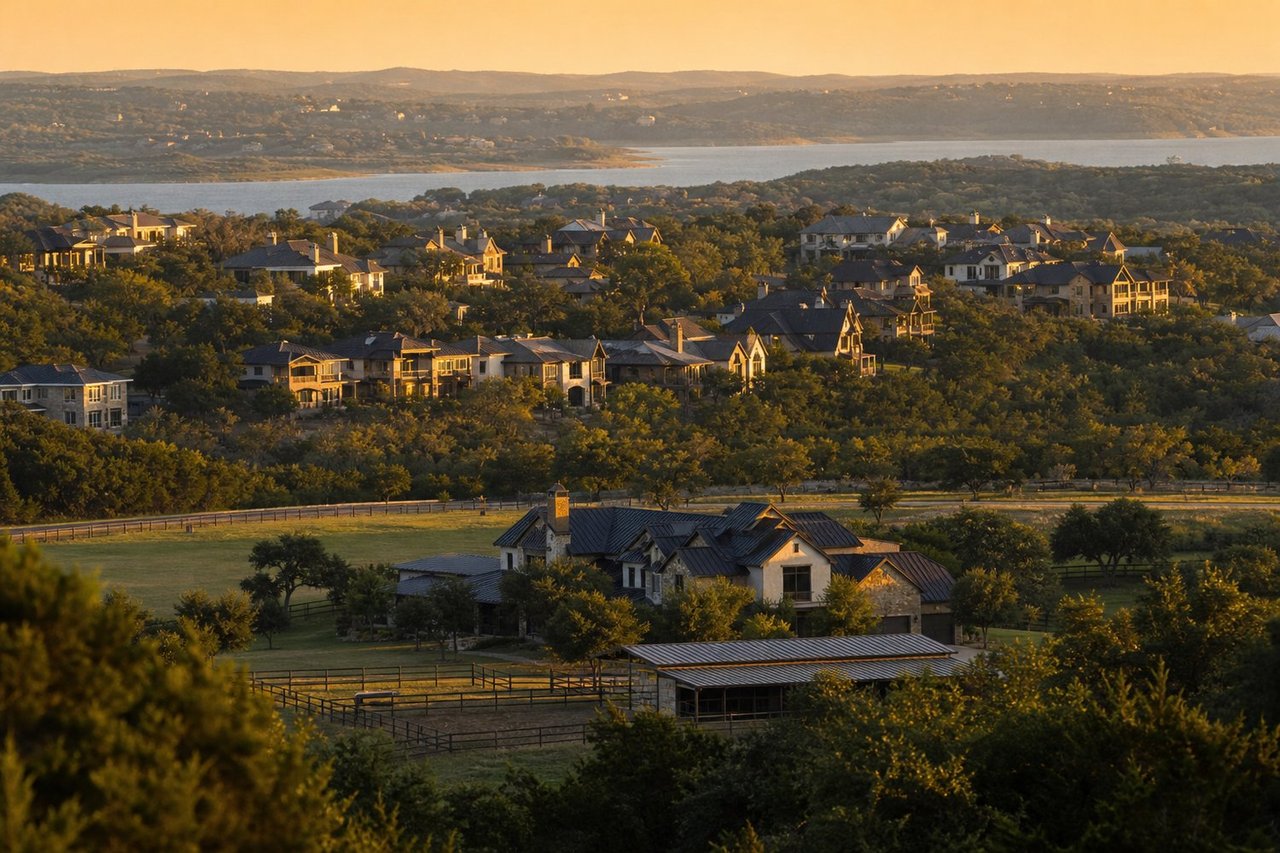
Before you compare listings, decide what the land has to do for you: hold a private homesite, support a well and septic system, or qualify for ag valuation. Price per acre is only the starting number. Water, access, and county rules decide whether a tract is worth what the seller is asking.
What should you know before buying Hill Country Estates with acreage near Austin?
Hill Country Estates with acreage near Austin sell on privacy, views, and usable land, and the regional rural-land benchmark was $8,040 per acre in Q2 2026, according to the Texas Real Estate Research Center at Texas A&M University. That figure covers the broad Austin-Waco-Hill Country region, not one county or one parcel. Your tract's price will turn on water, access, terrain, and development limits, so verify those before you write an offer.
Key Takeaways
- The Austin-Waco-Hill Country rural-land region recorded a median of $8,040 per acre in Q2 2026, up 8.63% from a year earlier, versus $5,218 per acre statewide (up 3.27%).
- That regional report covers a 39-county area and a sample of verified transactions, so it shows direction, not the value of any single tract.
- Single-family homes sold July to September 2026 in Crystal Falls had a median sale price of $734,878 and closed at 97.0% of list price, with 47% of listings taking a price cut.
- Water, septic, road access, and tax status (including ag exemption, MUD, PID, or WCID) can change what a tract is worth more than acreage alone.
- Burn bans are set county by county and can apply to unincorporated land, so confirm the current order where the property sits.
Jeff Joseph grew up in Austin, and he'll tell you the Hill Country doesn't sell as a spreadsheet. It sells as a sunset from a ridgeline, a gate that closes behind you, and a view with no neighbor's roof in it. The job is making sure the paperwork and the water hold up as well as the view does.
How much do Hill Country Estates with acreage cost near Austin?
The most recent regional benchmark available, from the Q2 2026 report, is a median of $8,040 per acre for the Austin-Waco-Hill Country region, up 8.63% year over year. Treat it as a market temperature reading, not a price tag for your parcel.
Austin-Waco-Hill Country region | Q1 2026 | Q2 2026 |
|---|---|---|
Median price per acre | $8,028 | $8,040 |
Change from a year earlier | +8.27% | +8.63% |
Reported sales | 1,078 | 1,062 |
Typical tract size in the data | 201 acres | 199 acres |
Sources: the Texas Real Estate Research Center's first-quarter 2026 land report and its Q2 2026 rural-land report.
What does that regional number actually tell you?
It tells you prices held near a record level through the first half of 2026 and that buyers are still paying up for land. The same Q2 report notes that recreational and homesite properties continued to support demand in this region.
It does not tell you what a 10-acre tract with a good well and a paved road will cost. A few limits to keep in mind:
- The data comes from a sample of verified transactions, not every land sale.
- The region spans 39 counties, so it is not an Austin or single-county median.
- The 199-acre typical tract describes the sales in the dataset, not what most listings look like.
- It is not an MLS inventory report, so it says nothing about how long listings sit or how offers are landing.
For comparison, the statewide median rural-land price was $5,218 per acre in Q2 2026, up 3.27%. The Hill Country region sits well above it.
What if a finished home in an established community fits better than raw land?
Then the numbers look different. Recent local market data for single-family homes sold July to September 2026 in Crystal Falls shows a median sale price of $734,878, compared with $737,500 in the same window a year earlier. That is area-level, and an individual home's value depends on condition, street, build year, and timing.
- 37 homes sold, against 38 a year earlier.
- Homes closed at an average of 97.0% of list price, with 6% selling above list and 83% below.
- Months of supply held at 4.4, and 19% of homes went under contract within two weeks of listing.
- 47% of listings had a price cut, averaging 3.2%.
That tells you there is room to negotiate on a well-prepared home that is priced honestly. Raw land has its own rhythm, which is why a local read on the specific tract matters more than any average.
What should you check before buying undeveloped Hill Country land?
Check water first, then septic and utilities, then tax status, then access and boundaries. A tract can have the best view in the county and still not support the house you want to build.
How do you verify usable water?
Ask for any existing well records and have the well's production tested by a qualified professional before you rely on it. If the property is served by a public water provider, confirm the provider and whether service reaches the homesite. Well capacity and water rights are the first questions in Jeff's land conversations, because they decide what you can realistically build and maintain.
Can you put in a septic system and build what you have in mind?
Without city sewer, a home generally needs an on-site septic system, and local rules govern what is allowed. Whether you can add a guesthouse or a barndominium depends on deed restrictions, county rules, septic capacity, and any city extraterritorial jurisdiction (ETJ) rules that touch the parcel. Confirm each one in writing before your option period ends, not after.
Does an ag exemption or special district change the carrying cost?
It can. An ag exemption may change the property tax picture on acreage, but qualifying depends on how the land is used and on the county appraisal district's rules, so confirm with the district rather than assuming it carries over. Some tracts also sit inside a MUD, PID, or WCID, and those add their own assessments or taxes. Jeff gives clients straight talk on those upfront, because they change the real monthly cost of owning the place.
What about survey, access, and easements?
On acreage, a current survey matters for boundaries, fences, easements, and legal access. Your title company will raise survey and T-47 questions during the contract period, and it is far cheaper to learn about a shared road or a pipeline easement before closing than after.
What are the wildfire and burn-ban risks?
Burn restrictions are set by county and can apply to unincorporated land, and they change with weather. As one example, Hill County issued emergency burn-ban regulations for its unincorporated areas in August 2026. (Hill County is a different county from the Hill Country region, but the lesson carries over.) Confirm the current order with the county where your property sits before you plan any brush burning.
How much land do you need for privacy and a homesite?
There is no magic acreage number. Privacy comes from where the house sits on the tract, the shape of the lot, tree cover, and elevation more than from raw acreage.
- Tract shape: A long, narrow 10 acres can feel more exposed than a compact 5 with the house set back.
- Homesite location: A building pad on a rise gives views, but it also affects well depth, driveway cost, and exposure.
- Neighbors and roads: Walk the boundary lines and note what you can see and hear from the spot where you would actually sit.
- Improvements: Existing barns, fencing, and a pool can matter as much as the raw acreage, and each carries its own upkeep.
Living in the Hill Country also tends to cost more than buyers expect once road maintenance, water systems, and insurance enter the picture. Plan for that now, not after you've closed.
Estate acreage or a finished luxury home?
If you want land without starting from scratch, Jeff's guide to acreage in Hill Country Estates near Austin covers what to expect on larger properties. If you would rather buy into an established community with Hill Country scenery, Grand Mesa is one example of space near Austin without the build. For the full sequence from search to closing, see Austin's Hill Country luxury home buying process.
What does working with a local agent change?
It shifts the work to the front. Jeff focuses on luxury and estate properties across Northwest Austin and the Texas Hill Country, and he knows which streets have the views, which builders are which, and which questions to put to the seller before the option period starts. If you want a read on a specific tract, that is a conversation to have before you fall for it. You can also see what to expect from a luxury REALTOR in Leander, Lakeway, and the Hill Country.
Curious how past clients describe working with Jeff? Read his reviews on Google, Zillow, and Realtor.com.
FAQ
How much does acreage near Austin cost per acre in 2026?
The regional median for the Austin-Waco-Hill Country area was $8,040 per acre in Q2 2026, up 8.63% from a year earlier. That is a 39-county benchmark drawn from a sample of verified sales, so a specific tract can price well above or below it depending on distance from Austin, water, access, and improvements.
Which Hill Country counties are best for buying land near Austin?
The best county depends on your priorities: distance from Austin, road access, water availability, and local rules. The regional research data does not rank individual counties, so compare each one on those factors. Jeff can help you narrow the field based on how you plan to use the land.
How do I verify whether a Hill Country property has usable water?
Start with any existing well records, then have the well's production tested by a qualified professional. If public water is available, confirm the provider and whether service reaches the homesite. Do this during your option period, before you are committed.
Are there restrictions on wells, septic systems, or development?
Yes, and they vary by parcel. Deed restrictions, county rules, and in some cases a city's ETJ can all affect what you can build, including a guesthouse or barndominium. Confirm each with the relevant authority and your title company before closing.
What are the wildfire and burn-ban risks for acreage outside Austin?
Burn bans are issued by county, can apply to unincorporated land, and change with weather conditions. Check the current order with the county where the property sits before any outdoor burning, and ask your insurance agent how wildfire exposure affects coverage.
Ready to look at land?
The regional data says Hill Country land has held its value, and the details of any single tract still decide your outcome. If you want to talk through acreage, a build, or a finished estate, Jeff walks clients through the numbers before they fall in love with a view.
Search Austin & Leander Homes →
Equal Housing Opportunity. Jeff Joseph, Texas Real Estate Sales Agent, TREC #752052, ERA Experts. Regulated by the Texas Real Estate Commission. This article is general information, not legal, tax, or financial advice. Confirm your own numbers with your title company, tax advisor, or lender.