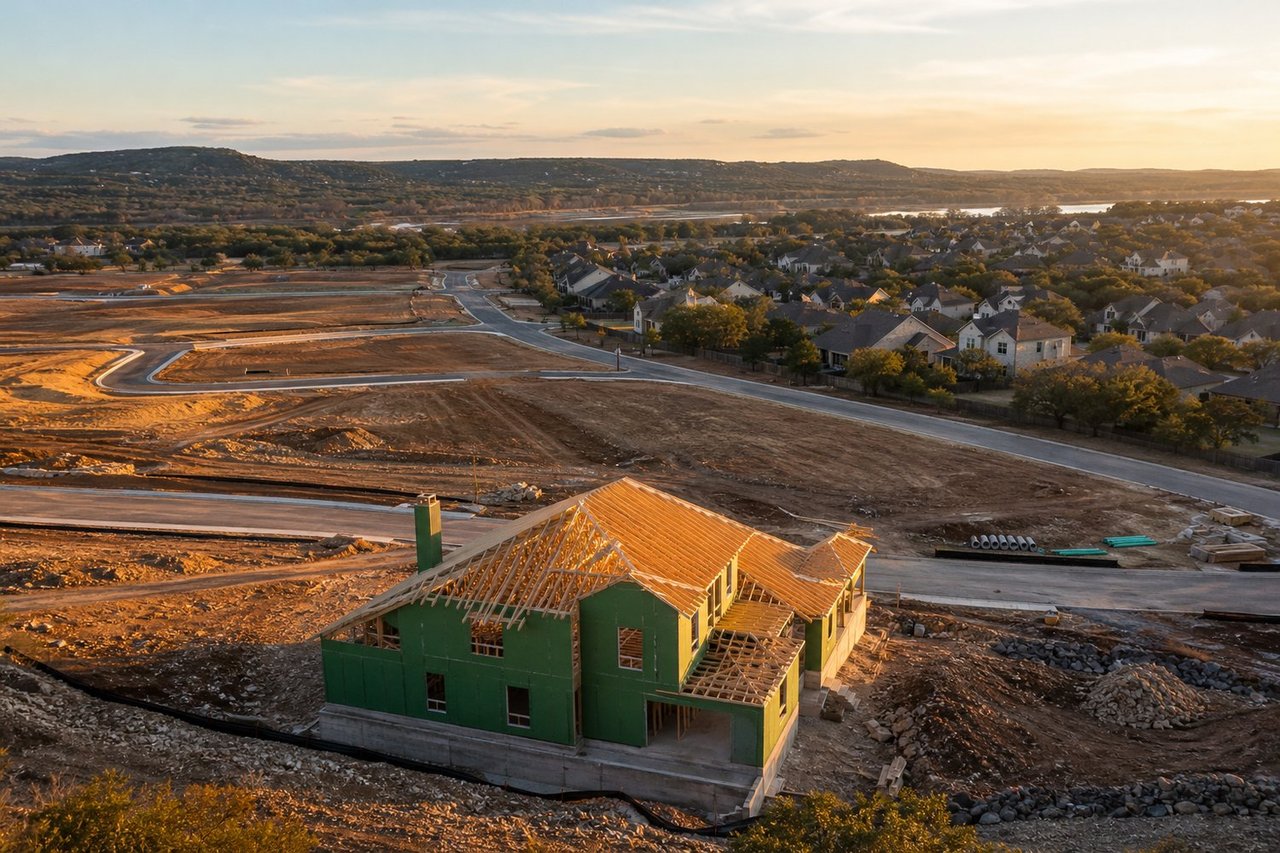
The decision that matters most is what the lot's tax statement will actually say. Before you fall for a floor plan, find out which MUD or PID touches the parcel, which builder incentives are written into the contract, and who inspects the home before drywall goes up.
What should you know before buying a new construction home in Austin?
Before you sign for a new construction home in Austin, verify every taxing entity on the exact lot (city, county, school district, MUD, and PID), get every builder incentive into the written contract, and hire your own inspector. Texas has no real estate transfer tax, but special-district taxes, assessments, and builder-contract charges can still change your monthly payment in ways the base price never shows.
Key Takeaways
- Single-family homes sold in Crystal Falls from July to September 2026 had a median sale price of $734,878, nearly flat against $737,500 in the same window a year earlier (-0.4%), according to recent local market data.
- Those Crystal Falls homes sold for an average of 97.0% of list price, and 83% sold below list, so an asking price is a starting point and not the final word.
- Leander adopted a city property-tax rate of $0.417282 per $100 of taxable value for fiscal 2026-27, but that is only the city's piece of your total tax bill.
- A PID assessment is collected on the consolidated property-tax bill, while a MUD is a separate governmental entity, so they are two different line items to verify.
- Texas has no real estate transfer tax, yet title company, lender, prepaid, survey, and builder-related charges still appear on a new-build closing statement.
How do MUD and PID taxes change the cost of a new construction home in Austin?
They add layers on top of the base property tax, and the amounts depend on the exact parcel, not the subdivision name. Jeff puts this conversation first with new-build buyers, because a floor plan priced well can still carry an ownership cost the brochure never mentions.
What is a PID, and who pays it?
A PID (Public Improvement District) is a financing district whose assessment pays for specified improvements or services. The amount and the length of time depend on that district's own service-and-assessment plan. The City of Leander explains that annual PID assessments are not sent in a separate bill. The county tax office collects them through the consolidated property-tax bill.
The assessment applies to assessable property in the district and is paid by the property owner unless the transaction documents provide otherwise. For 2026, Leander scheduled a public hearing to update each applicable PID's service-and-assessment plan and assessment roll, so the numbers get refreshed every year.
What is a MUD, and is it the same thing?
No. A MUD (Municipal Utility District) is a separate special-purpose governmental entity. In Texas it can provide or finance water, wastewater, drainage, and related infrastructure, and it generally collects revenue through utility charges and property taxes. Whether your lot sits inside a MUD, which one governs it, and what it charges all have to be confirmed through the district and county tax records. Don't accept a rate from a sales office or a neighbor's bill.
How do you find out what applies to your lot?
Ask for the parcel's current tax information and identify every taxing or assessment entity attached to it. If your contract gives you an option period, or a builder equivalent, use that window to verify, because builder contracts vary. Then work through this list:
- City and county: which governs the address, and what each charges.
- School district: which district's tax rate applies to the parcel.
- MUD: yes or no, which district, and its current tax rate.
- PID: the current annual assessment, remaining term, and whether early payoff is available. Ask for the service-and-assessment plan and assessment roll.
- HOA: dues, deed restrictions, and anything the builder collects at closing.
For scale, Leander's adopted city rate for 2026-27 is $0.417282 per $100 of taxable value, made up of a $0.274483 maintenance-and-operations rate and a $0.142799 debt-service rate. That took effect with the fiscal year beginning October 1, 2026, and it is only the city component. Nearby communities can differ materially, so compare Leander, Steiner Ranch, and any Austin address parcel by parcel.
What do recent Crystal Falls sales say about pricing a new construction home in Austin's northwest suburbs?
They give you a reality check. Builders set their own prices, but a buyer can set that number beside what single-family homes actually sold for nearby. Recent local market data for Crystal Falls (a Leander-area neighborhood) shows a flat, negotiable market, which is useful context when a builder quotes a price.
Measure (Crystal Falls) | Figure | Why it matters to you |
|---|---|---|
Median sale price, single-family homes sold July to September 2026 | $734,878 (-0.4% vs. $737,500 a year earlier) | An area-level anchor, not a value for any one home |
Median sale price per square foot, same window | $237 | Useful for comparing a plan's size against its price |
Homes sold, same window | 37 (38 a year earlier) | A steady, not frantic, volume of sales |
Average sale price as a share of list price, same window | 97.0% (96.3% a year earlier) | Sale prices landing a bit under list |
Months of supply, same window | 4.4 (4.4 a year earlier) | Supply unchanged year over year |
Went under contract within two weeks of listing | 19% | Most homes did not move in the first two weeks |
Newly listed homes with a price cut | 47% (average cut 3.2%) | Sellers adjusting after hitting the market |
In the same window, 6% of homes sold above list price and 83% sold below. The median asking price of newly listed homes was $767,180, which sits above the median sale price. That gap is the negotiating room buyers are working with. These figures cover all single-family sales in the neighborhood, not only new builds, and your own result depends on condition, street, build year, and timing.
When Jeff evaluates a builder's price for a client, he uses a comp method: the same subdivision or within a quarter mile, sales from the last 90 days (widening to 180 if fewer than three comps turn up), built within 10 years of the plan, and within 300 square feet. A newer resale next door is often the cleanest comparison for a spec or inventory home.
What costs and site conditions catch buyers off guard?
The ones that live outside the base price: closing-statement charges, incentives that aren't in writing, and lot conditions in the Hill Country that show up after you own the home. None of them can be priced from a blog, so each one needs your specific contract and site plan.
What can show up at closing on a new build?
Texas has no real estate transfer tax, per the Texas Comptroller of Public Accounts. That does not mean the closing statement is light. Expect categories such as title company charges, recording fees, lender charges, prepaid taxes and insurance, survey-related costs, inspection costs, HOA charges, and builder-related items. Several of these are negotiable, so confirm who pays what in the purchase contract instead of assuming custom. Jeff walks clients through a personalized estimate before they commit, because the numbers depend on your loan, your contract, and your closing date.
How should you treat builder incentives?
As contract terms, never as verbal promises. Rate buydowns, upgrades, appliances, landscaping, title company credits, and closing-cost contributions belong in the executed agreement or a written addendum. Ask three questions:
- Does the incentive require the builder's preferred lender or title company?
- Does it change or disappear if the closing date moves?
- Is it a credit, a price reduction, or an upgrade, and where does the contract say so?
The builder's sales representative works for the builder. A buyer's agent works for you. For a deeper walk through the paperwork, read what Austin buyers should know before signing a new construction contract.
Do you still need an inspection on a brand-new home?
Yes. A new home can still have drainage, grading, HVAC, roofing, plumbing, electrical, or finish defects. Consider independent inspections at multiple stages, commonly before drywall, at the completed-home phase, and at the final walk-through, subject to site access and the builder's rules.
What does Hill Country living add that you won't see on the price sheet?
Lake and Hill Country ownership tends to cost more than buyers expect, and much of it is lot-specific. On western and northwest Austin lots, investigate these before you commit:
- Steep or irregular lots, extensive grading, and retaining walls
- Rock excavation and the drainage paths it creates
- Wildfire exposure and tree restrictions
- Private roads and long driveways
- Septic or limited utility arrangements, and well capacity on acreage
- Landscaping requirements and deed restrictions
Don't apply a dollar guess to any of these without the site plan and the builder's documentation. For acreage and estate-style properties, Austin's Hill Country luxury home buying process covers the land-side questions in more depth.
What does the process look like from start to close?
Exact steps and deadlines are builder- and contract-specific, but the sequence usually runs like this:
- Select the lot and plan.
- Sign the builder's contract and confirm the written incentives.
- Complete the lender's underwriting.
- Monitor construction and schedule independent inspections.
- Complete the final walk-through.
- Confirm utilities and the certificates required for occupancy.
- Close through the title company.
Weighing a new build against a resale in the same community? Jeff's breakdown of new construction vs. resale in Travisso shows how that decision plays out. Out-of-state buyers can also read how to buy a home in Austin from afar, since a build timeline is a natural fit for a long-distance move.
If you'd like to see how other buyers and sellers rate working with Jeff, read his reviews on Google, Zillow, and Realtor.com.
FAQ
What taxes will I pay on a new-construction home in Leander?
You'll pay city, county, and school district property taxes, plus any MUD tax or PID assessment attached to your parcel. Leander's adopted city rate for 2026-27 is $0.417282 per $100 of taxable value, but that is only the city component. Your parcel's complete tax statement is the only number that counts.
How do I find out whether a new home is in a MUD or PID?
Ask for the parcel's current tax information and check it against the district and county tax records. Don't rely on the subdivision name, because phases within one community can have different taxing jurisdictions or assessment schedules. Jeff helps clients run this check before they write an offer.
Who pays the PID assessment when I buy a newly built home?
The property owner pays it, unless the transaction documents provide otherwise. In Leander the assessment is collected through the consolidated property-tax bill. Confirm the current annual amount, the remaining term, and any payoff option for your specific parcel.
Does a MUD tax replace city property taxes?
A MUD is a separate governmental entity, so treat it as its own layer and not as a substitute. A home's total tax burden can include city, county, school district, and special-district taxes. Get the parcel's full tax statement and read every line.
What costs can a builder require me to pay at closing in Texas?
It depends entirely on your contract, so read the closing-cost and incentive terms before you sign. Texas has no real estate transfer tax, but closing statements can include title company, recording, lender, prepaid tax and insurance, survey, inspection, HOA, and builder-related charges. Responsibility for negotiable items should be spelled out in the agreement, not assumed.
Ready to run the numbers on a build?
Buying a new construction home in Austin comes down to verifying the lot, the taxes, and the contract before you fall for the model home. Jeff Joseph specializes in new construction, relocation, and VA loans (see the VA home purchase process in Austin), and he'll help you check every taxing entity and incentive on the specific parcel you're considering.
Search Austin & Leander Homes →
Equal Housing Opportunity. Jeff Joseph, Texas Sales Agent, regulated by the Texas Real Estate Commission. This article is general information, not legal, tax, or financial advice; confirm your own numbers with your title company, tax advisor, or lender.